







Pain Management EHR buyers' guide
Pain management physicians deal with unique challenges like chronic pain tracking, opioid prescription monitoring, and multidisciplinary treatment plans.
Using a general-purpose EHR not built for these needs can lead to inefficiencies and compliance risks.
This is why many clinics seek pain management software tailored to their specialty. A specialized EHR comes pre-loaded with relevant templates and tools, helping your practice chart procedures, monitor outcomes, and stay compliant with regulations more easily.
Why select a pain management-specific EHR?
Unlike generic systems, these systems include content and features that understand your specialty. For example, it will have built-in ICD-10 and CPT codes relevant to pain medicine (without clutter from other fields) and templates for common pain procedures.
You won’t have to shoehorn your workflow into an eye clinic’s EHR or constantly customize from scratch. In fact, some top pain management EHR platforms allow you to use or adapt templates that mirror your existing paper forms and protocols.
Specialty-specific software also keeps up with pain management regulations. For instance, with opioid prescribing under heavy scrutiny, a pain-focused EHR often provides tools like morphine milligram equivalent (MME) calculators and direct Prescription Drug Monitoring Program (PDMP) checks built into the prescribing module.
In short, the best EHR for pain management will actively support your clinical decisions and compliance needs.
Features to look for
When comparing solutions, pay attention to whether they offer the following key features and benefits:
- Pain-specific templates and charts: The system should come with pre-built templates for pain management encounters, like procedure notes for epidural injections, nerve blocks, ablations, or implantable device trials. Look for pain diagrams or mapping tools that let you mark areas of pain on anatomical images; some EHRs provide detailed body diagrams for annotating injection sites and pain locations, which can improve accuracy and clarity in your records.
- Customized workflow and ease of use: The interface should minimize clicking through multiple screens. Ideally, it enables viewing all crucial patient info (history, vitals, imaging, lab results) on one screen during a visit. Support for voice dictation or even AI-driven ambient clinical scribes can further streamline documentation. Some systems use voice recognition and learning algorithms to recall your frequent diagnoses and automatically suggest codes or phrases, reducing typing. The goal is an intuitive workflow that lets you chart faster and focus on patients, not paperwork.
- Advanced e-Prescribing (EPCS) and compliance: Since pain specialists often prescribe controlled substances, e-prescribing features are a must. Ensure the EHR supports Electronic Prescribing for Controlled Substances (EPCS) and integrates with your state’s PDMP for one-click prescription monitoring. This lets you track opioid prescriptions and check for potential abuse in-platform; some EHRs embed risk assessment tools or MME calculators right in the workflow, helping you make safer prescribing decisions. Also look for alerts or audit trails that flag high-risk scenarios (e.g. a patient on long-term high-dose opioids) so you can intervene appropriately.
- Patient scheduling and history tracking: Managing a pain clinic means frequent follow-ups and tracking progress over time. Your EHR should include/integrate with a practice management module that handles scheduling, referrals, and billing. Specialized systems often include patient visit history and prior treatments easily when booking or documenting a new appointment. Support for unique scheduling needs (coordinating procedures that require equipment or multiple providers) is a plus. Integration with workers’ compensation workflows is also valuable, since many pain practices deal with occupational injury cases; an EHR might have specific templates or fields for work comp claims and automated form generation to ease that documentation.
- Patient engagement tools: Patients expect convenience. A portal is a good place to start; patients can log in 24/7 to view their health information, track their progress (e.g. pain scores or test results), and message your team securely. Online self-scheduling or appointment requests, automated appointment reminders (email/text), and the ability for patients to fill out intake forms or pain questionnaires online are useful too. These not only improve patient satisfaction but also reduce no-shows and administrative burden.
- Telehealth and remote monitoring: Especially in chronic pain management, telehealth can play a role in follow-ups and monitoring. Many of the top pain management EHR platforms now integrate telemedicine visits. This allows you to conduct virtual check-ins or consults for medication adjustments and post-procedure follow-ups within the EHR itself. Even more, consider whether the software supports remote patient monitoring (RPM) tools like electronic pain diaries or wearable integrations. Some systems capture patient-reported outcomes (e.g. daily pain scores, functional questionnaires like the Oswestry Disability Index) via mobile apps or portals between visits. This data can trigger alerts for the care team if a patient’s pain suddenly worsens, enabling proactive intervention.
Popular pain management EHR/EMR solutions
There are many pain management software options on the market, ranging from large, general EHR platforms to niche systems designed solely for pain clinics. Leading general EHRs such as Epic, Oracle Health, and NextGen are used in pain management settings and offer modules or content for this specialty.
They excel in interoperability and breadth of features, though they can be complex or costly for smaller clinics. On the other hand, the following specialty-specific solutions focus heavily on pain management workflows out of the box:
>
| Software | Fit for Pain Management |
|---|---|
| ModMed (EMA) | Strong specialty fit for pain practices |
| Compulink Advantage | Broad specialty support, integrated workflow |
| Meditab IMS | Scalable/customizable for pain workflows |
| CureMD All-in-One | General and specialty support |
| Praxis EMR | Highly customizable, helpful for unique workflows |
| Ambula EMR | Strong for ASCs & interventional pain clinics |
| iSalus OfficeEMR | All-in-one for small–midsize pain practices |
| PrognoCIS EMR | Good for multi-site practices needing deep integrations |
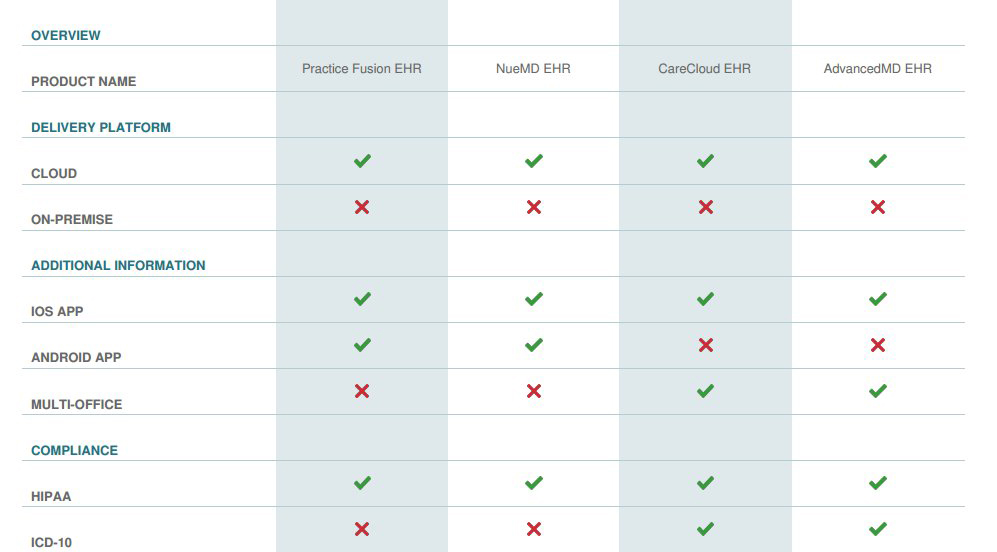
When researching vendors, it’s important to note how each product addresses the crucial features discussed above. The “best” EHR for your pain management practice will be the one whose strengths align most closely with your workflow and priorities.
Ongoing costs and maintenance are often under-discussed pre-purchase. Some practices report surprise at maintenance fees or minor issue escalation despite “premium” pricing.